
Lesson 11 of 15 Part 3: How the story got told
The fairy tale
In the shock and confusion after the flood, a story took flight: a monster storm drowned a corrupt city below sea level, and the Army Corps had been forced by local officials and environmentalists to build an inferior system. None of it holds up.
In the post-flood environment of shock and confusion, a fairy tale took flight about a monster storm drowning a corrupted city that lay below sea level. A second story, repeated for years, was that the Army Corps of Engineers was hamstrung by a politically connected levee board that “forced” the agency to build the inferior system that failed in August 2005.
Levees.org exists to separate the real from the fairy tale. This lesson shows how the fairy tale got started, and why it is wrong.
Four weeks: the testimony
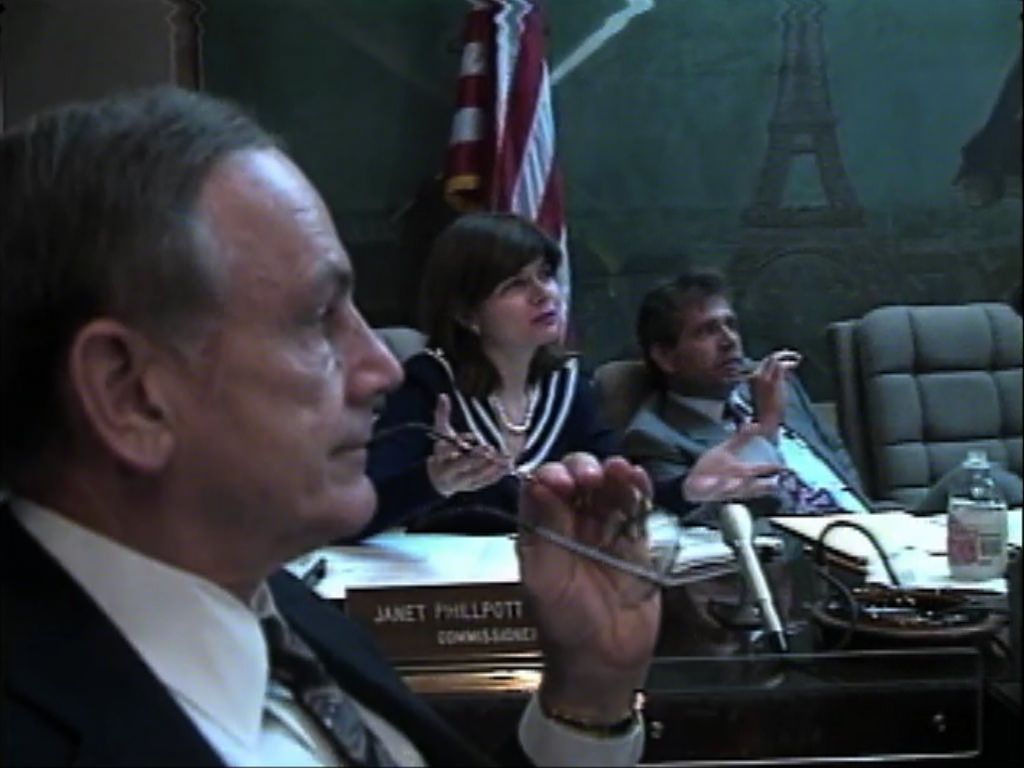
On September 28, 2005, the House Appropriations Subcommittee on Energy and Water Development held a hearing on the costs of the flood. Members of Congress, who would decide how much aid the people of Greater New Orleans received, needed accurate information.
Anu Mittal, Director of Natural Resources and Environment at the GAO, testified on why the levees were still not complete. She read from a script that bore little resemblance to the written report she submitted that day:
After the (levee) project was authorized in 1965, the Corps started building the barrier plan … parts of the project faced significant opposition from local sponsors and they did not provide the rights of way that the corps needed to build the project on schedule. But most importantly there were serious concerns relating to environmental impacts of the control barriers … This ultimately resulted in a legal challenge and in 1977, the courts enjoined the corps from constructing the barrier complexes. — Anu Mittal, GAO, verbal testimony, September 28, 2005
The effect was lethal. The clear takeaway was that the Corps had struggled to finish the flood protection but was hamstrung by local officials and environmentalists. One member of Congress can be heard on the video: “It’s obvious. It’s their fault!”
Years later, after painstaking research, Sandy Rosenthal found that the verbal remarks were loosely based on a 22-year-old GAO report from 1982 — a report that, in fact, reprimanded Army Corps officials for their glacial pace. Ms. Mittal later readily admitted her verbal testimony was “from three or four decades ago.” No transcript of the hearing was ever sent to the Government Publishing Office. If not for C-SPAN, it might have been lost forever.
It was well understood that there was pressure from the White House, constantly and early on, to assign blame on the residents of New Orleans for the failure of the levee system. — U.S. Senator Mary Landrieu, interview with Sandy Rosenthal, November 10, 2015
Seven weeks: “levee board reform”
Just seven weeks after the flood, with the city barely dewatered and some souls yet to be discovered in their attics, a small group calling itself the Business Council of New Orleans had already decided where the fault lay. By October 20, 2005, it had a plan on paper to reorganize the way levee officials were selected. Using full-page newspaper ads and purchased media, the group quickly convinced a traumatized populace.
At the same time, the U.S. Attorney, the state Attorney General and the Orleans Parish District Attorney all announced investigations of levee-related corruption. An Associated Press story circulated coast to coast reported, wrongly, that “local agencies handle most of the building and maintenance of levees.” The local agencies controlled none of the building.
The investigations were eventually closed with no indictments — and no press. In 2006, more than 80 percent of Louisiana voters approved consolidating the region’s levee boards. It was years before any investigation concluded who was responsible for the flooding. (You can read what the reform did and didn’t accomplish in What changed.)
Blaming the janitor “It seemed to me that, if the levees broke, one should look to the architect and to the contractor, which, in this case, was the Army Corps. To me, blaming the local Orleans Levee Board was like blaming the janitor if a building fell to the ground.” — Sandy Rosenthal, Words Whispered in Water
The commander’s statement
There were more than a dozen harmful falsehoods, but perhaps the most damaging was what Army Corps commander Lt. Gen. Carl Strock told the New York Times: that while the Corps was responsible for the levee failures, New Orleans officials deserved a share of the blame for the failure of the 17th Street and London Avenue Canals. Local agencies, he said, had forced the Corps to build an inferior system. The message was repeated for years by other Corps brass and public affairs staff.
That statement effectively let the Corps off the hook. It gave the American people a reason to blame New Orleans flood survivors for their misfortune.
In 2012, Levees.org filed a records request for the documents behind that claim. The Corps’ New Orleans District public affairs chief replied: “It is not possible to determine exactly which documents … were relied upon, considered, reviewed, read or discussed.” Then Lt. Gen. Strock admitted to the Times-Picayune that there was no documentation to support his statement:
I might have illustrated my description with things I had heard but not personally researched, but there was absolutely no intent to deceive anyone. — Lt. Gen. Carl Strock, 2012
Gates or higher walls: what really happened
The heart of the fairy tale concerns the three big drainage canals. Here is the record, from the Orleans Levee Board’s own meeting minutes and the federal Decision-Making Chronology.
After Hurricane Betsy, Congress directed the Army Corps to work with the Sewerage and Water Board and the Orleans Levee Board on protecting the drainage canals. The Corps narrowed its options to two: raise the canal walls (“parallel protection”) or install gates at the canal mouths (“frontage protection”). The Corps considered both plans equally effective. It preferred gates for the London Avenue and Orleans Avenue Canals because they were cheaper — not better — in keeping with its mandate to choose the least-cost alternative. Higher walls were estimated to cost three times more for the London Avenue Canal and five times more for the Orleans Avenue Canal.
For the 17th Street Canal, there was no significant difference in cost, and the Corps itself recommended the higher walls.
Meeting minutes from 1988 to 1991 reveal a highly engaged engineering committee at the Orleans Levee Board that grilled the Corps with detailed questions. The board and the Sewerage and Water Board worried that untested gates without pumps would trap rainwater inside the city when they were shut. The prototype gates had already failed in a model test at the Corps’ Waterways Experiment Station in Vicksburg. In a briefing paper to the congressional delegation, the board wrote that if the canal levees were overtopped, “an estimated 56,000 residents of Orleans Parish would be flooded.”
So, in full transparency — backed by the New Orleans City Council, the Sewerage and Water Board and neighborhood groups — the levee board hired a lobbyist and went to Congress for the more expensive plan. Language in the 1990 Water Resources Development Act made the canals part of the federal hurricane project, and Congress ordered the Corps to raise the walls. The Corps was aware the whole time.
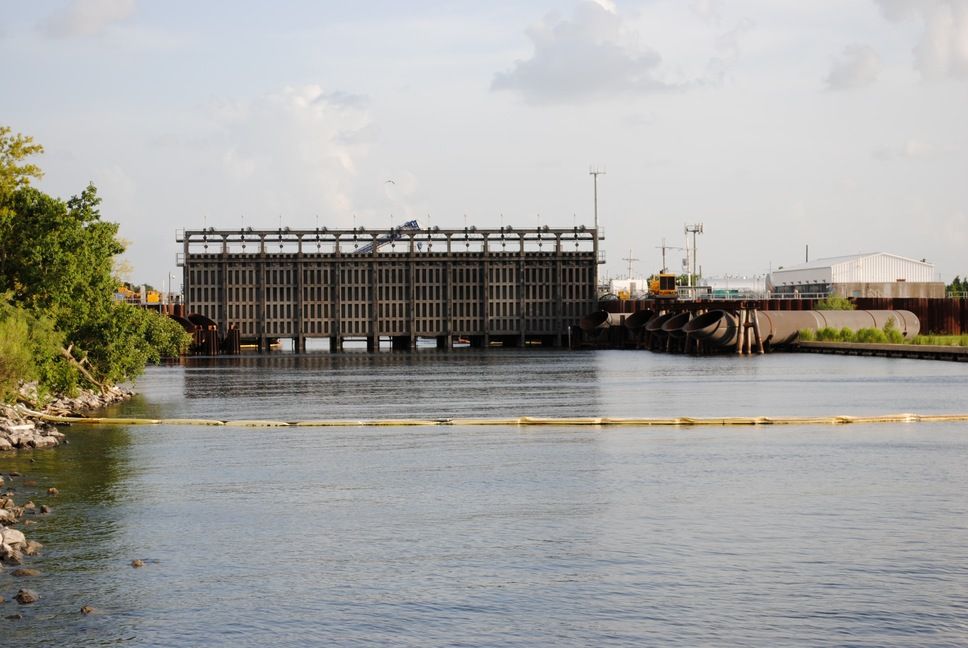
Fifteen years later, a Los Angeles Times article on Christmas Day 2005 described “a deft behind-the-scenes maneuver” by the levee board that forced the Corps to accept higher floodwalls. There is no evidence to support this claim of subterfuge, but it has been repeated in books and news stories ever since.
There are two logic flaws in blaming the local agencies. First, the Corps had an obligation to build its Congress-mandated flood protection competently, whichever plan was chosen. Second, there were about 50 breaches on August 29, 2005. Passing the buck on the canal walls assumes the Corps’ gates-without-pumps plan would have protected the city. After Katrina, the Corps installed gates — with enormous pumps.
I could not fault the OLB for lobbying for the same style protection plan for the Orleans and London canals as the corps had previously recommended for the 17th Street Canal. — J. David Rogers, 2015
The walls failed because the sheet piles were too short. That was the Corps’ decision alone.
The environmentalists and the barrier plan
Between 1970 and 1975, the Army Corps developed a Barrier Plan for massive sea gates east of New Orleans, at the Rigolets and Chef Menteur passes. In 1976, a small group called Save Our Wetlands sued over the Corps’ cursory Environmental Impact Statement. Federal Judge Charles Schwartz noted that the EIS consisted of only four typewritten pages — most run to hundreds or thousands — and issued an injunction until the Corps revised it. He wrote that upon proper compliance, “any hurricane plan thus properly presented will be allowed to proceed.”
The Army Corps never came back with a better EIS. In 1980, its own analysis concluded that higher levees were less costly, less damaging to the environment, and more acceptable to local interests.
One must acknowledge that nothing prevented the Corps from acting more quickly to perform a sufficient environmental review and get the project approved. Had it believed that superior benefits of the option justified increased costs, it could surely have moved forward. — Robert Verchick, Facing Catastrophe (2010)
The drive-by inspections
Three months after the flood, the Times-Picayune reported that annual levee inspections in Orleans Parish tended to be quick drive-by affairs ending with a lunch for 40 to 60 people. The story suggested lax maintenance by the levee board contributed to the flooding.
But those were the Army Corps’ inspections. Under federal regulation, the Corps annually inspected the Orleans Levee District’s maintenance of the federal project — a quality audit of grass-cutting and debris removal. It would be a conflict of interest for the levee board to inspect its own work. From 1959 to 2004, the Orleans Levee District received a grade of “Outstanding” for its levee maintenance.
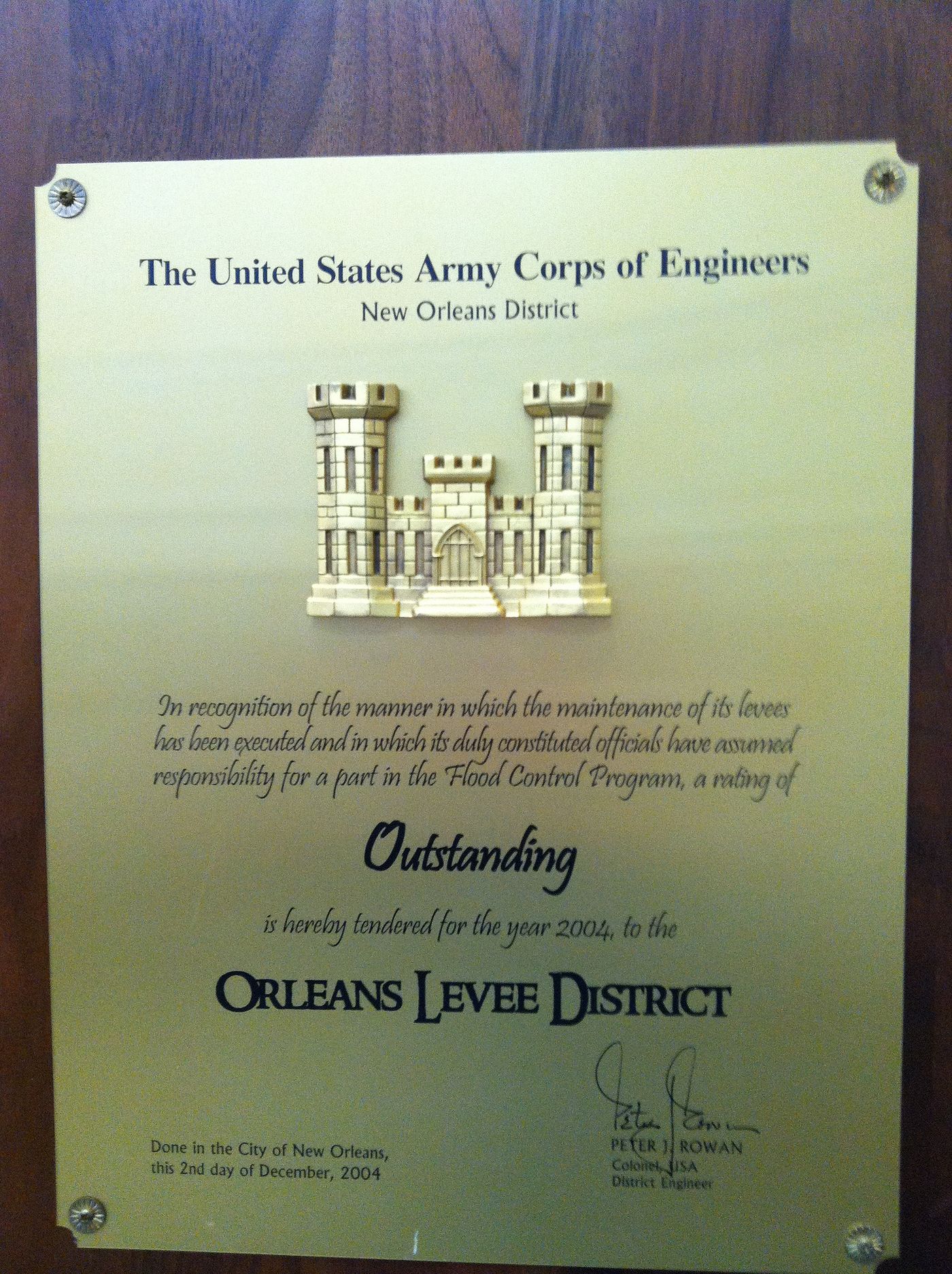
And no visual inspection could ever have spotted engineering flaws deep underground. As the Decision-Making Chronology put it, the annual inspections “do not … include the types of engineering assessments that would be needed to verify structure stability and performance.” The drive-by inspections are a red herring.
Why it matters
These statements were made by people in positions of authority, at the moment when the whole nation was watching and Congress was deciding how much to help. Levees.org has long believed they harmed southeast Louisiana’s recovery by alienating the nation’s citizens and prejudicing members of Congress.
They also hid the most important lesson for everyone else. If New Orleans flooded because of local corruption and bad geography, then the rest of America has nothing to worry about. If it flooded because the federal agency that builds America’s levees made a deadly engineering mistake to save money, then 201 million people do.
In the next lesson, we look at how the language itself — two little words, “Katrina flooded” — kept the fairy tale alive.
Go deeper
Sources
- Levee Exhibit: Role of the Orleans Levee Board; Role of Environmentalists; Drive-by Inspections
- Woolley & Shabman, Decision-Making Chronology (2008), p. ES-14 and p. 2-58
- Robert Verchick, Facing Catastrophe (Harvard University Press, 2010), p. 233
- Save Our Wetlands v. Rush, U.S. District Court (Judge Charles Schwartz), 1977