
Lesson 13 of 15 Part 4: Why it matters to you
What changed
The levee breach event was not a shining moment for American engineering, but it was a pivotal moment in American history. It changed how the nation builds, inspects and governs levees — though not always as much as it should have.
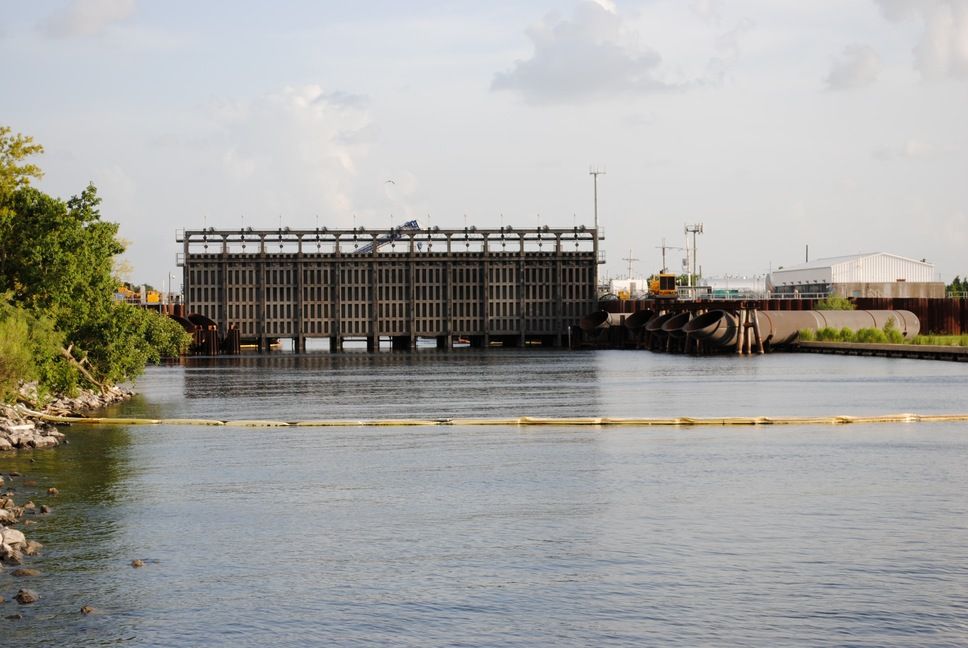
Though the levee breach event was not a shining moment for American engineering, it was a pivotal moment in American history. The nation took a different path because of the engineering failures. Sixty-two percent of the American population lives in counties protected by levees, and the changes that followed 2005 reached nearly all of them.
New national laws
The National Levee Safety Act of 2007. After the levee failures, Congress attached levee safety legislation to the Water Resources Development Act. It ordered the Secretary of the Army to create:
- a national database of federal and non-federal levees,
- the first-ever nationwide levee safety program,
- a levee safety inspection tool using global positioning technology,
- a 16-member levee safety committee, and
- a program to inform the public of the risks of living near levees.
The new initiatives were to be completed from 2008 through 2013. Most were implemented around 2008 and 2009. But the national levee safety program itself was not launched by the Army Corps and FEMA until 2022 — fifteen years later.
The original bill, modeled on the nation’s dam safety program, included a quasi-independent Safety Review Board. Three revisions later, the final bill was less than half the length of the original, and it gave even more responsibility — without independent oversight — to the Army Corps, the entity primarily responsible for the drowning of New Orleans. As Levees.org put it at the time, giving the Corps more authority over levees after Katrina was like giving BP more authority over deep-sea drilling safety after the 2010 Gulf disaster.
Corps reform. The McCain-Feingold Corps Reform Amendment to the Water Resources Development Act passed the Senate by a narrow margin, 54 to 46. It established clear triggers for independent panel review of costly (over $40 million) or controversial Army Corps feasibility studies, and pressured the Corps to consider outside recommendations. Levees.org was critical in winning U.S. Senator Mary Landrieu’s support for the amendment.

The National Flood Risk Management Program. In May 2006, the Army Corps created a program to integrate its flood risk work with other federal agencies, provide accurate floodplain information to the public, assess hazards posed by aging infrastructure, and raise public awareness of flood risk.
New ways of building and inspecting levees
Perhaps most important of all, the Army Corps changed the way it builds levees. In 2006, Corps headquarters issued new guidance on the deficiencies discovered in the design of I-walls in New Orleans — the gap that forms between sheet pile and soil under flood loading. Working with the nation’s civil engineers, the Corps used what it learned from the forensic investigations to rewrite the manuals used to build new structures, incorporating a modern understanding of hurricane risk and expected sea-level rise.
Inspections changed too. Before Katrina, routine annual inspections were visual only. The New Orleans breaches showed that visual inspections could not reveal design or construction problems deep underground. In September 2007, the Corps issued new guidelines for inspecting and certifying federal levees (Engineer Circular 1110-2-6067): no more grandfathering, exemptions or partial certifications. Nationwide, the Corps began requiring continuous inspections by local sponsors with new checklists, GPS-based inspection tools, periodic inspections with a screening assessment every five years, and data-intensive risk assessments every ten years.
The breaches also revealed that flood zone maps were badly outdated. FEMA launched a five-year, $1 billion initiative to modernize its Flood Insurance Rate Maps. Those new maps, in turn, drove an overhaul of the National Flood Insurance Program and steep premium increases for policyholders across the country. In other words, every flood insurance customer in America is paying for what happened in New Orleans.
A new system for New Orleans
The Greater New Orleans urban flood protection system now has no peer in the nation in cost, population and property protected. On a scale of one to ten, if it were a ten, the next closest system would be a three. Among the changes since 2005:
- Gates with massive pump stations at the mouths of the 17th Street, Orleans Avenue and London Avenue Canals, plus a “safe water” level in each canal below the top of the walls.
- T-walls at the breach sites; deeper sheet piling; soil-cement mixing to strengthen levees; relief wells that act as warning gauges.
- Armored levees in New Orleans East and St. Bernard, rebuilt with suitable materials and protected with grass and riprap.
- The Lake Borgne Surge Barrier, a $1.1 billion, mile-long wall with navigable gates where the GIWW and MR-GO meet, which together with the Seabrook gates keeps surge out of the Industrial Canal.
- The MR-GO was closed after the Corps’ own 2008 study found no federal interest in keeping it open.
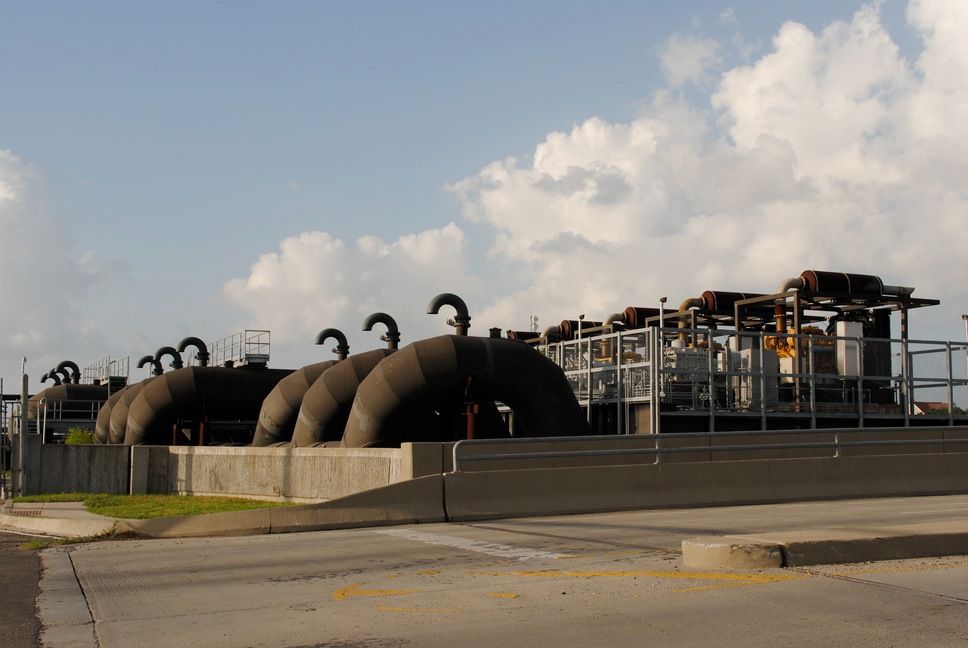
The system still depends on the same agency, and on maintenance. In 2019, the Corps asked Congress for $3.2 billion to raise the levees again to account for sea level rise and subsidence.
Levee board reform — and its limits
Before Katrina, five different levee districts served as separate local sponsors of the federal flood protection in the greater New Orleans area. In the chaotic months after the flood, the presumption — made in haste — was that the Orleans Levee Board had not paid enough attention to flood protection. Congress ordered the creation of a single state agency to be the local sponsor, and Louisiana created the Coastal Protection and Restoration Authority (CPRA). In 2006, more than 80 percent of Louisiana voters approved a constitutional amendment creating two regional “super boards”: the Southeast Louisiana Flood Protection Authorities East and West.
Louisiana became the first state in the nation to require board members with professional expertise in hydrology and engineering. It had to write the legislation from scratch, because no model existed anywhere in the country. California soon followed with its own package of flood bills.
But the new authorities soon discovered that their authority was limited. In 2014, Stephen Estopinal, then acting president of SLFPA-East, called it the “authority without any authority” and listed examples of the Army Corps ignoring the board’s concerns. Before Katrina and now, the Army Corps is 100% in charge of design, construction and the instructions for maintenance. What the board does have, Levees.org says, are “screaming rights”: the ability to sound off to local and congressional officials when it sees a problem with the Corps’ plans.
A report card For more than 40 years before Katrina, the Orleans Levee Board received a grade of “outstanding” from the Army Corps for its levee maintenance. In 2018, a Levees.org records request revealed that the new post-Katrina authorities had received a grade of “minimally acceptable” every year for the previous decade.
Levees.org has kept working to make the reform live up to its promise:
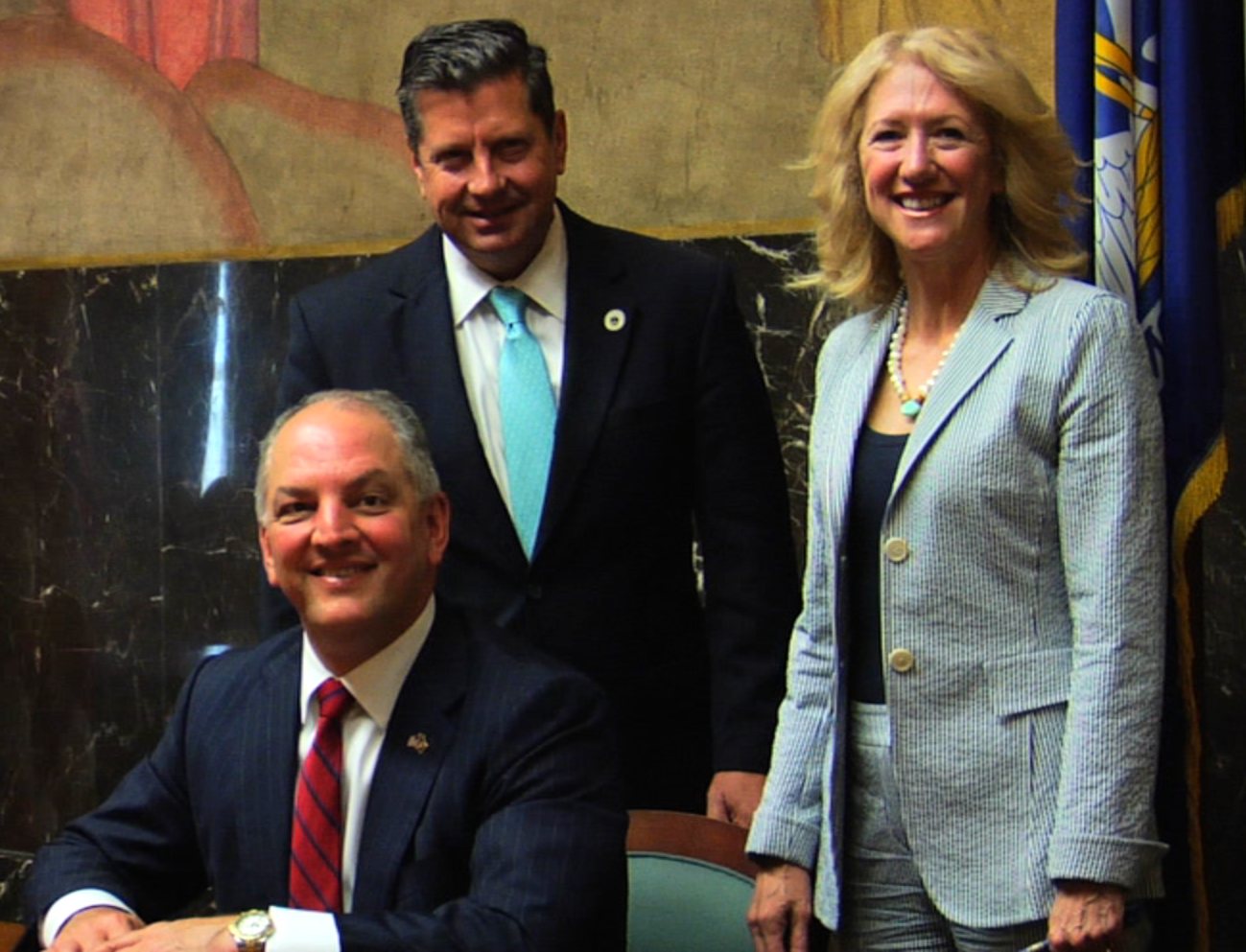
- 2017: Levees.org mobilized its members behind House Bill 266, sponsored by Rep. Patrick Connick, requiring term limits for the small nominating committee that chooses the flood authority board — the group that decides who will spend upward of $60 million of taxpayer money each year. The bill passed 37–0 in the Senate and 97–0 in the House. Governor John Bel Edwards invited Sandy Rosenthal to the signing.
- 2024: Levees.org joined others in petitioning against a plan to fold the CPRA into the Department of Natural Resources. The plan was put on hold.
- 2025: Levees.org’s members urged legislators to keep an expert nominating committee, rather than the governor, in charge of selecting flood authority board members.
What hasn’t changed
The Flood Control Act of 1928 is still the law. The Army Corps is still immune from paying damages when its flood control projects fail. And the independent, bipartisan investigation that Levees.org fought for — the 8/29 Investigation — never happened.
The post-Katrina changes to levee building and the scrutiny of levees already built both happened because of the levee breach event in New Orleans. In the end, they made the majority of the American people safer from flooding. The next lesson explains just how many Americans that is.
Go deeper
- Levee Exhibit: New Legislation that Changed America
- Fifteen years later, the National Levee Safety Program finally being rolled out
- How Congress Rewarded the Corps of Engineers for Drowning New Orleans
- Levees.org's campaign for better flood protection laws (HB266)
- Can Levee Board Members Force the Corps' Hand?
- Steep Flood Insurance Rate Hikes has Roots in Corps' Levee Mistakes
Sources
- Water Resources Development Act of 2007, including the National Levee Safety Act and McCain-Feingold Corps reform provisions
- U.S. Army Corps of Engineers, Engineer Circular EC 1110-2-6067 (levee inspection and certification), 2007
- U.S. Army Corps of Engineers, Engineering Technical Letter ETL 1110-2-575