
Lesson 10 of 15 Part 3: How the story got told
In court
A federal judge found the Army Corps responsible for the floodwall failures and for the MR-GO disaster. Not one dollar of damages followed, because of a law written in 1928.
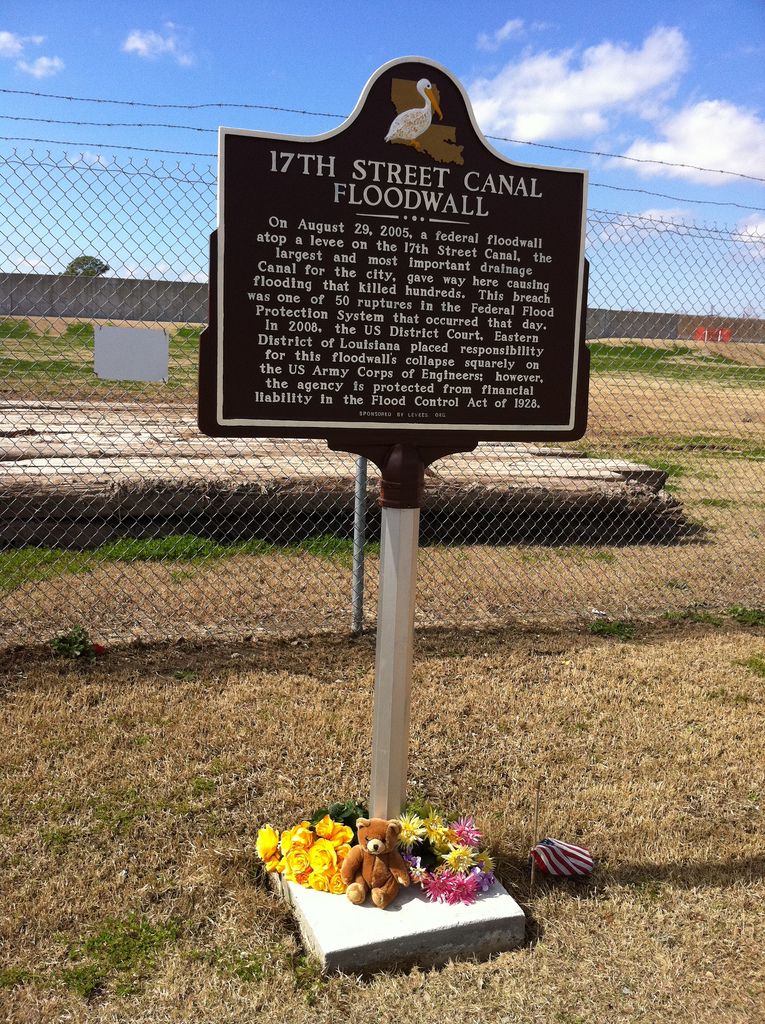
Numerous class action lawsuits were filed against the Army Corps of Engineers after the 2005 flood. Federal Judge Stanwood Duval consolidated them into two separate cases. Between them, they produced some of the most important findings in the whole story — and one of its cruelest ironies.
The LEVEE case: responsible, but immune
The case commonly called the “LEVEE case” covered areas that flooded because of the drainage canal floodwall failures and the Inner Harbor Navigation Canal failures.
In January 2008, Judge Duval placed responsibility for the floodwall collapses of the 17th Street and London Avenue Canals, and the resulting flooding in downtown New Orleans, squarely on the Army Corps. But the agency could not be found financially liable, because of the sovereign immunity established by the Flood Control Act of 1928. Section 702c of that law says the United States shall not be liable for “any damage from or by floods or flood waters at any place.”
Judge Duval dismissed the case, and it was not appealed. His words have become part of the record:
The cruel irony here is that the Corps cast a blind eye, either as a result of executive directives or bureaucratic parsimony, to flooding caused by drainage needs and until otherwise directed by Congress, solely focused on flooding caused by storm surge. Nonetheless, damage caused by either type of flooding is ultimately borne by the same public fisc. Such egregious myopia is a caricature of bureaucratic inefficiency. — Judge Stanwood R. Duval Jr., January 2008
While the United States government is immune for legal liability for the defalcations alleged herein, it is not free, nor should it be, from posterity’s judgment concerning its failure to accomplish what was its task… because of §702c, there is neither incentive, nor punishment to insure that our own government performs these tasks correctly. — Judge Stanwood R. Duval Jr., January 2008
The MR-GO case: liable — for six months
The MR-GO lawsuit alleged that the Army Corps was negligent in its maintenance of the 76-mile shipping channel it built in the mid-20th century. It covered residents east of the Industrial Canal: New Orleans East, the Lower Ninth Ward, St. Bernard Parish and portions of the Upper Ninth Ward.
In November 2009, Judge Duval ruled that the Army Corps’ mismanagement of the MR-GO was directly responsible for flood damage in St. Bernard Parish and the Lower Ninth Ward, and that the Corps’ actions “resulted in a catastrophic loss of human life and property in unprecedented proportions.”
It was the first time that the government has been held liable for any of the flooding that inundated the New Orleans area after Aug. 29, 2005, vindicating the long-held contention of many in the region that the flooding was far more than an act of God. — Campbell Robertson, New York Times, November 2009
In March 2012, the U.S. Fifth Circuit Court of Appeals ruled that Duval was correct, and even strengthened the case with observations of its own. (Two of the judges on the panel were appointed by George W. Bush and one by Ronald Reagan; all three were from Texas.) Six months later, the same panel reversed its own decision. The Army Corps was immune from damages because of a provision that protects a federal agency when it makes a “discretionary” decision. The U.S. Supreme Court refused to hear the appeal.
What the Flood Control Act of 1928 means for you
The 1928 law was written after the great Mississippi River flood of 1927. It still protects the federal government from paying for damage caused by failed flood control projects.
Judge Duval's ruling shows the Flood Control Act of 1928 must be repealed. It must be done before the administration receives another judgement against it. And most importantly, it must be done before more lives are lost.— Sandy Rosenthal, November 2009
The people of New Orleans who lost loved ones, homes, businesses and neighborhoods did not receive a dime from the organization responsible for the levee breach event. Compare that to the collapse of the Champlain Towers South condominium in Surfside, Florida, in 2021: there was quick acknowledgment of the problems that led to the disaster, and within one year all parties came together to compensate the victims, with a settlement of over a billion dollars. Florida also passed new legislation requiring recertification of older condominiums.
The levee district settlements
In September 2009, Judge Duval approved a settlement of a federal class action lawsuit against the Orleans Levee District; together with settlements by the East Jefferson and Lake Borgne Basin levee districts, the total came to about $20 million, to be divided among some 120,000 claims. Years later, checks arrived — some as little as $3.
Myth The local levee districts must be guilty of negligent maintenance, because they settled.
Truth A settlement is neither proof of culpability nor acceptance of responsibility. It’s a settlement, and nothing more.
Here’s why. The settlement money came from insurance policies the levee districts held on the levees. Insurance companies risk being found in “bad faith” if they refuse a legitimate settlement offer within policy limits — which could make them liable for the full amount of any later judgment, even beyond those limits. The damages claimed for the levee and floodwall failures were many billions of dollars. Each insurer had the choice to pay a few million dollars, or roll the dice and possibly end up bankrupt. It’s not hard to see why a rational insurer would settle even if it believed the allegations had no merit.
The plaintiffs’ side was rational, too. Their attorneys get paid from the settlement. Going to trial would cost a fortune, and even a win might not make it possible to seize assets from the levee districts. In a case like this, the settlement reflects legal strategy on the part of both defendants and plaintiffs.
In 2017, Corinne Zimmerman, whose husband drowned near the 17th Street Canal breach, called Sandy Rosenthal to ask whether her $400 check meant the Orleans Levee Board was admitting responsibility. Rosenthal explained the settlement, and that a federal judge had already found the Army Corps responsible for the breach.
She asked me, “Is this it? It’s over? Maybe I shouldn’t cash this check?” I advised her to cash the check, and spend it in a way her deceased husband would approve. — Sandy Rosenthal, “What does that Katrina check really mean?” (2017)
The courts confirmed what the engineers found. But by the time they ruled, a very different story had already taken hold in the minds of millions of Americans. That story is the subject of the next lesson.
Go deeper
Sources
- In re Katrina Canal Breaches Consolidated Litigation, U.S. District Court for the Eastern District of Louisiana, January 2008
- MR-GO ruling, Judge Stanwood Duval, November 2009; U.S. Court of Appeals for the Fifth Circuit, March and September 2012
- Flood Control Act of 1928, 33 U.S.C. § 702c