Get the book →
Primary sources

The record

Don't take our word for it. Here are the investigations, rulings and books behind every lesson on this site.

Major levee investigations

Seven major studies, listed newest first. Levees.org is the only website that hosts every one of them, including the Army Corps' own IPET report.

Cover of Interaction between the US Army Corps of Engineers and the Orleans Levee Board preceding the drainage canal wall failures in New Orleans
2015

Interaction between the US Army Corps of Engineers and the Orleans Levee Board preceding the drainage canal wall failures in New Orleans

J. David Rogers, G. Paul Kemp, H.J. Bosworth Jr., and Raymond Seed · Water Policy 17(4)

This watershed paper retracts wrong conclusions made in the 2006 ILIT report about what caused the levee failures. The levees failed mainly due to a mistake the Army Corps made in the 1980s when interpreting the results of its levee load test study. The paper is also a “one stop shop” that addresses most, if not all, of the significant issues and events relating to the cause of the 2005 flooding.

Corrects the record: the Orleans Levee Board did not cause the canal wall failures.
Cover of Interagency Performance Evaluation Task Force (IPET)
June 2009 (final)

Interagency Performance Evaluation Task Force (IPET)

Convened by the U.S. Army Corps of Engineers · Lewis E. Link, John Jaeger, Jeremy Stevenson, et al.

The Army Corps committed to a thorough investigation of how the New Orleans hurricane protection system performed, and tasked the American Society of Civil Engineers with an external peer review. The report is thorough and admits that the hurricane protection did not perform as designed. In 2019, the Corps removed it from its website.

A self-study: managed by the agency responsible for the system's performance.

Cover of The New Orleans Hurricane Protection System
April 2009

The New Orleans Hurricane Protection System

National Academy of Sciences / National Research Council

The NAS reviewed the Corps-sponsored 7,500-page IPET draft final report, reflecting on the lessons learned and offering advice on improving hurricane protection for the New Orleans area. Perhaps most interesting is its complete lack of any discussion of the local New Orleans levee board.

Cover of Decision-Making Chronology for the Lake Pontchartrain and Vicinity Hurricane Protection Project
March 2008

Decision-Making Chronology for the Lake Pontchartrain and Vicinity Hurricane Protection Project

Douglas Woolley and Leonard Shabman, for the U.S. Army Corps of Engineers

The 333-page report explains in detail why the levee protection was built as it was. Two key points are in the report but not in the executive summary: the Corps itself selected the high walls plan for the 17th Street Canal, and the Corps made a mistake in the 1980s when it chose to shorten the steel sheet pilings. Highly technical but thorough, because it had more time and resources than the earlier studies.

Levees.org's recommended starting point for research.

Cover of The New Orleans Hurricane Protection System: What Went Wrong and Why
June 2007

The New Orleans Hurricane Protection System: What Went Wrong and Why

American Society of Civil Engineers External Review Panel · C.F. Andersen, J.A. Battjes, D.E. Daniel, et al.

Convened at the request of the Corps' Chief of Engineers to examine and validate the methods, models, data and findings of IPET. The concise 82-page report is easily digestible for laypersons. It found that the majority of the damage was due to the levees failing. (Its accompanying press release was found to be misleading.)

Cover of Team Louisiana: The Failure of the New Orleans Levee System during Hurricane Katrina
March 2007

Team Louisiana: The Failure of the New Orleans Levee System during Hurricane Katrina

Ivor van Heerden, G. Paul Kemp, Ezra C. Boyd, et al. · for the Louisiana Department of Transportation and Development

Led by the deputy director of the LSU Hurricane Center on a budget of $130,000, plus $250,000 from the McKnight Foundation, which allowed the team to examine some of the Army Corps' modeling in detail. Dr. van Heerden might be the first person to suggest that the Army Corps was not being entirely honest with the public.

Cover of Independent Levee Investigation Team (ILIT)
June 2006

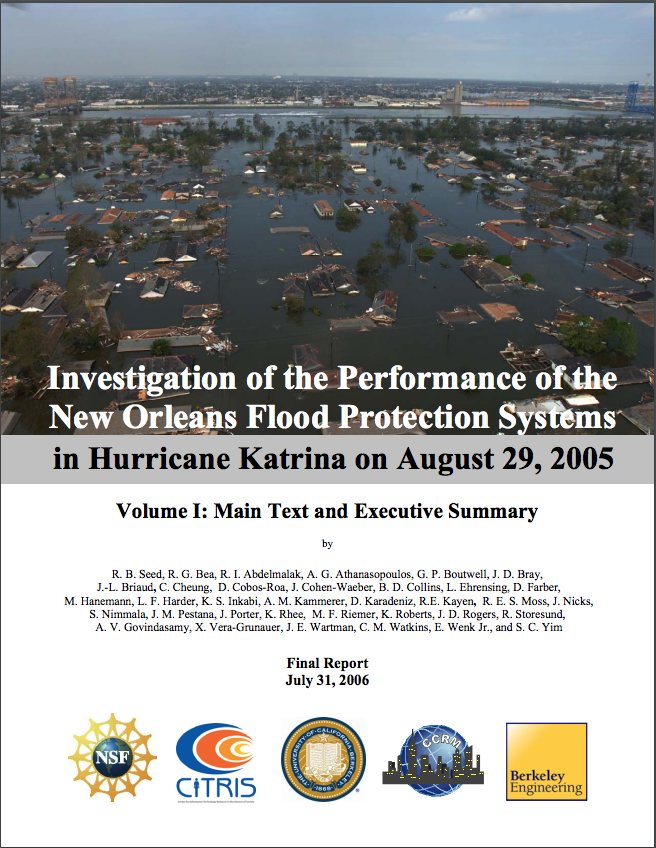
Independent Levee Investigation Team (ILIT)

Raymond Seed, Robert Bea, J. David Rogers, et al. · funded by the National Science Foundation

The first major study of the 2005 levee breaches. It found a large number of engineering errors and poor judgments. The team also wrongly concluded that the levees failed partly due to objections by the Orleans Levee Board to gates at the north ends of the drainage canals — a conclusion Drs. Rogers and Seed retracted in Water Policy in 2015.

Partly retracted in 2015.

In court

  • January 2008 — the LEVEE case. Judge Stanwood Duval, U.S. District Court for the Eastern District of Louisiana, places responsibility for the 17th Street and London Avenue Canal floodwall failures on the Army Corps, but dismisses the case under the Flood Control Act of 1928. Lesson →
  • November 2009 — the MR-GO case. Judge Duval holds the Corps liable for flooding caused by its mismanagement of the Mississippi River Gulf Outlet. Affirmed by the Fifth Circuit in March 2012, then reversed by the same panel six months later; the Supreme Court declined to hear the appeal.
  • September 2009 — levee district settlements. Insurers for the pre-Katrina levee districts settle a class action. A settlement is not an admission of wrongdoing.

Books

  • Words Whispered in Water: Why the Levees Broke in Hurricane Katrina by Sandy Rosenthal (Mango, 2020; Anniversary Edition, Turner, 2025). Winner of the Nautilus Award for Journalism & Investigative Reporting.
  • Path of Destruction by John McQuaid and Mark Schleifstein (Little, Brown, 2006).
  • The Storm: What Went Wrong and Why During Hurricane Katrina by Ivor van Heerden (2006).
  • Breach of Faith by Jed Horne (2006).
  • Catastrophe in the Making by William R. Freudenburg, Robert Gramling, Shirley Laska and Kai T. Erikson (Island Press, 2009), which cites the work of Levees.org.
  • Facing Catastrophe by Robert R.M. Verchick (Harvard University Press, 2010).
  • Rising Tide by John M. Barry, on the Mississippi River flood of 1927.

Read Sandy Rosenthal's book reviews at Levees.org.

Film, audio and tours

  • The Big Uneasy (2010), a documentary by Harry Shearer about the levee failures.
  • Floodlines (2020), the award-winning podcast from The Atlantic, which heavily features Levees.org.
  • The Slingshot, the podcast from Levees.org.
  • The virtual levee breach tour on NewOrleansHistorical.org, created with UNO, the Louisiana State Museum and the New Orleans Public Library.

Levees.org resources