
Lesson 6 of 15 Part 2: Why the levees broke
The London Avenue Canal
The London Avenue Canal floodwall failed on both sides — a testament to how unreliable the walls were before Hurricane Katrina arrived. Next door, the Orleans Avenue Canal shows what the same walls did when they didn't breach.
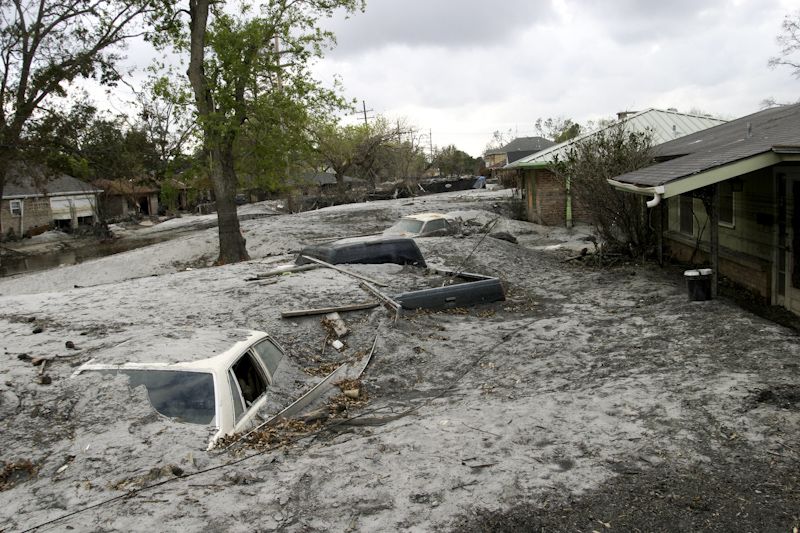
Before the 2005 flood, the area next to the east breach site of the London Avenue Canal was a thriving, mixed neighborhood of white and African American, middle-class homeowners. Oak, pine, cypress and pecan trees grew throughout the neighborhood and at the base of the canal’s levee.
Today it is home to two of Levees.org’s most important educational sites: the Flooded House Museum and the Levee Exhibit Hall & Rain Garden, at 4918 and 5000 Warrington Drive.
The east breach
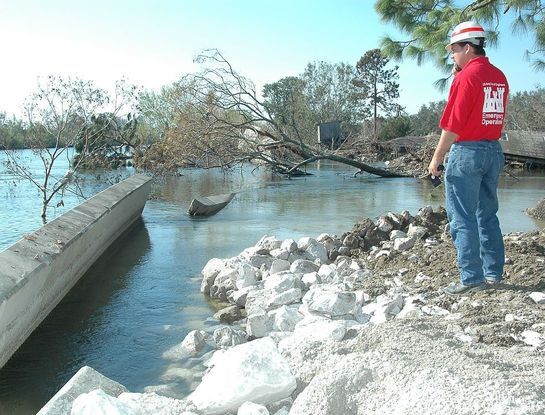
On the morning that Hurricane Katrina arrived, several concrete levee monoliths — 30-foot-long sections of floodwall — failed near Mirabeau Avenue, sending torrents of water and sand into the adjacent neighborhood. The home that once stood in front of the breach site was picked up, rotated nearly 180 degrees, carried 100 feet and deposited in the middle of Warrington Drive.
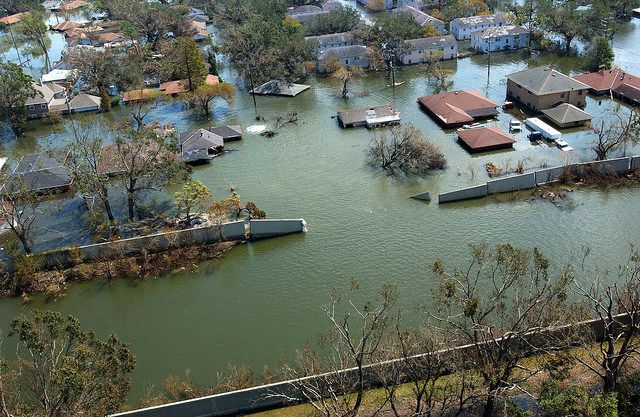
Storm surge water poured through the gap, killing hundreds directly and indirectly and costing millions in property and infrastructure damage. At failure, the water level in the canal was about 2.5 feet lower than the top of the wall and represented about 50 percent of the load the wall was designed to hold.
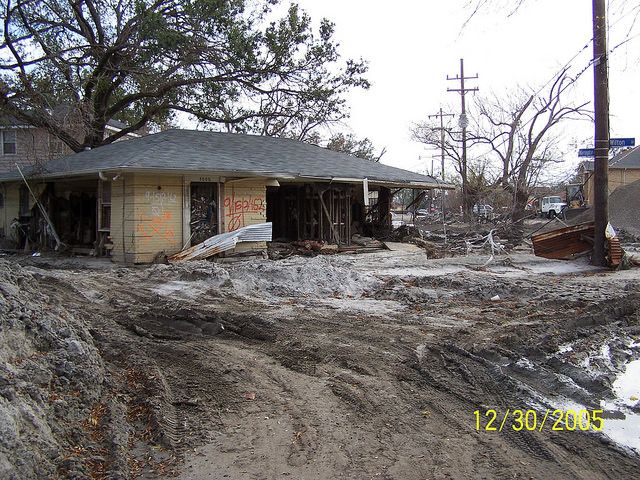
Post-disaster studies conclude that the steel sheet pilings were driven to depths that were too shallow. In recommending I-walls with such short sheet pilings, the Army Corps made a recurring mistake and relied upon its misinterpreted E-99 study conducted near Morgan City. At a savings of $100 million, the Corps wrongly concluded it could drive the steel pilings of the London Avenue Canal to depths of not more than 17 feet instead of between 31 and 46.
Also critical to the failure here: in designing the floodwalls, the Army Corps did not take into account a 50-foot-thick sand layer just below the soil. This highly permeable sand allowed water to seep under the levee, resulting in a blowout and collapse of the floodwall. Lots of that sand ended up in the streets of Gentilly.
Team Louisiana, in the second of the major forensic studies, determined that this oversight meant the levees’ factor of safety was only 50 percent. According to the Army Corps-sponsored investigation (IPET), the catastrophic breaches of the London Avenue Canal represented a failure of the system to meet its design objectives.
The west breach
Three-quarters of a mile north, near Robert E. Lee Boulevard, another concrete monolith failed on the opposite side of the canal, directly flooding the Lake Vista neighborhood, a primarily white, middle-class area. The water also flooded Bayou St. John and Mid-City.
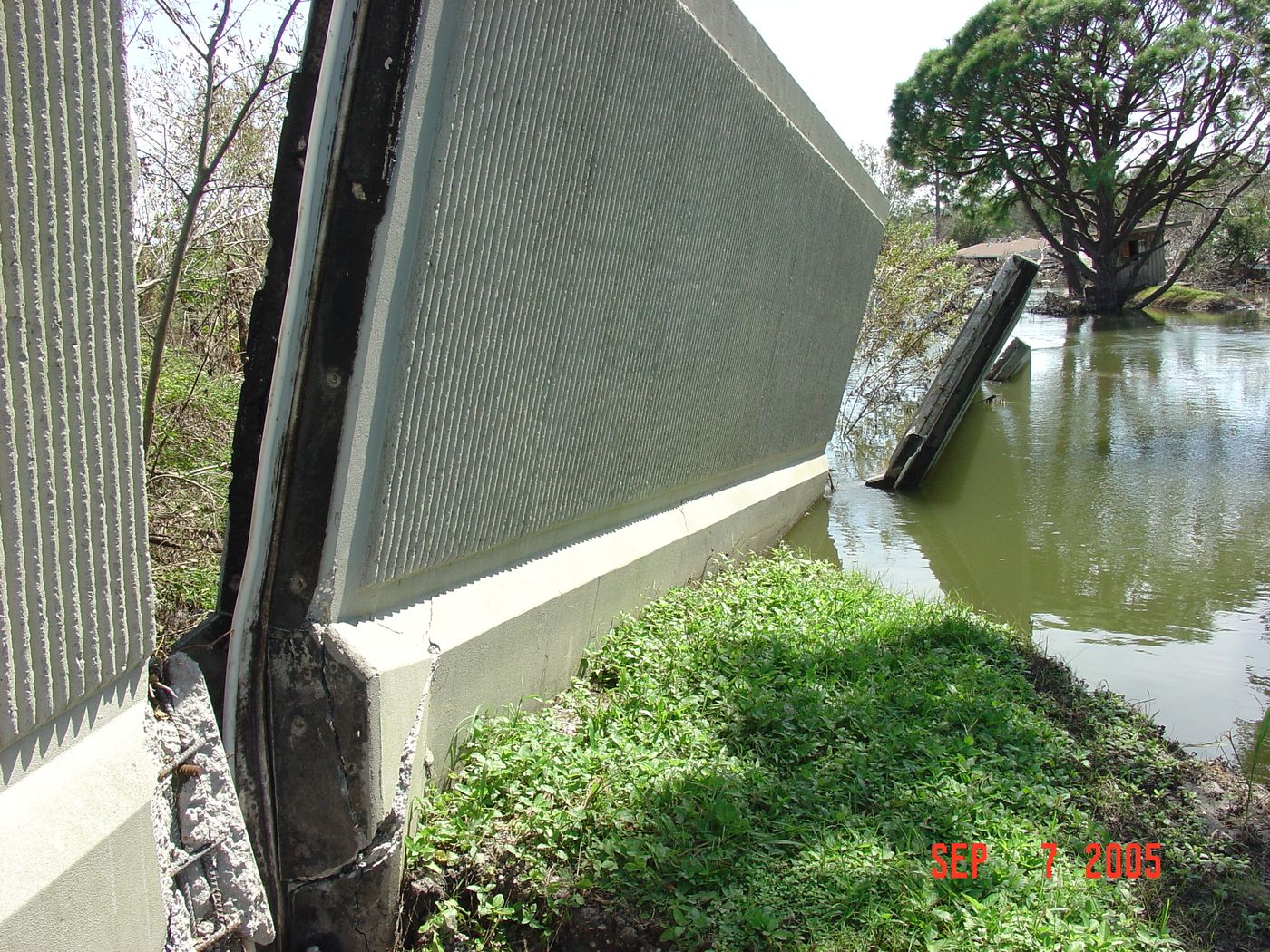
The reasons for the west side failure were similar to those at the 17th Street Canal: the Army Corps’ failure to drive steel sheet pilings to proper depths. The fact that the canal walls failed on both sides of the London Avenue Canal is a testament to the weakness of the floodwalls.
Why higher walls instead of a gate?
After Hurricane Betsy, the Army Corps recommended two plans for the London Avenue Canal — raising the height of the levees with floodwalls, or installing floodgates at the canal’s mouth at the lakefront. The Corps felt both alternatives provided equally sufficient storm surge protection. (Unlike the gates built after Katrina, the gates proposed in the 1980s did not include auxiliary pump stations.)
Because raising the walls of the London Avenue Canal was three times more expensive than the gates plan, the Army Corps recommended the gates, in keeping with its congressional mandate to choose plans with the most favorable cost-benefit ratios.
The Orleans Levee Board and the Sewerage and Water Board feared that the much cheaper gates-only plan was incompatible with their interior drainage responsibilities: when the gates were shut during a hurricane, the pump stations would not be able to pump rainwater out of the city. They also questioned whether the untested prototype gates would work at all; the gates had already failed in a much-publicized model test at the Corps’ Waterways Experiment Station in Vicksburg. So, in 1991, the two agencies asked their congressional delegation to push for the more expensive “higher walls” plan — the same plan the Army Corps had already selected for the much larger 17th Street Canal. The effort worked, and Congress ordered the Corps to raise the walls.
What the expert said “I could not fault the OLB for lobbying for the same style protection plan for the Orleans and London canals as the corps had previously recommended for the 17th Street Canal.” — J. David Rogers, co-chair of the first independent levee investigation, 2015
The higher walls were not the problem. The problem was how the Corps built them. You will hear more about how the gates-versus-walls decision was later twisted into a story of local blame in the lesson The fairy tale.
The canal that didn’t breach
The Orleans Avenue Canal runs between the 17th Street and London Avenue Canals. Its levees were raised the same way — using sheet pilings that were too short — but they did not breach. This was due, in part, to an unintended 100-foot-long “spillway”: a section of wall significantly lower than the adjacent newer floodwalls, near Pump Station No. 7.
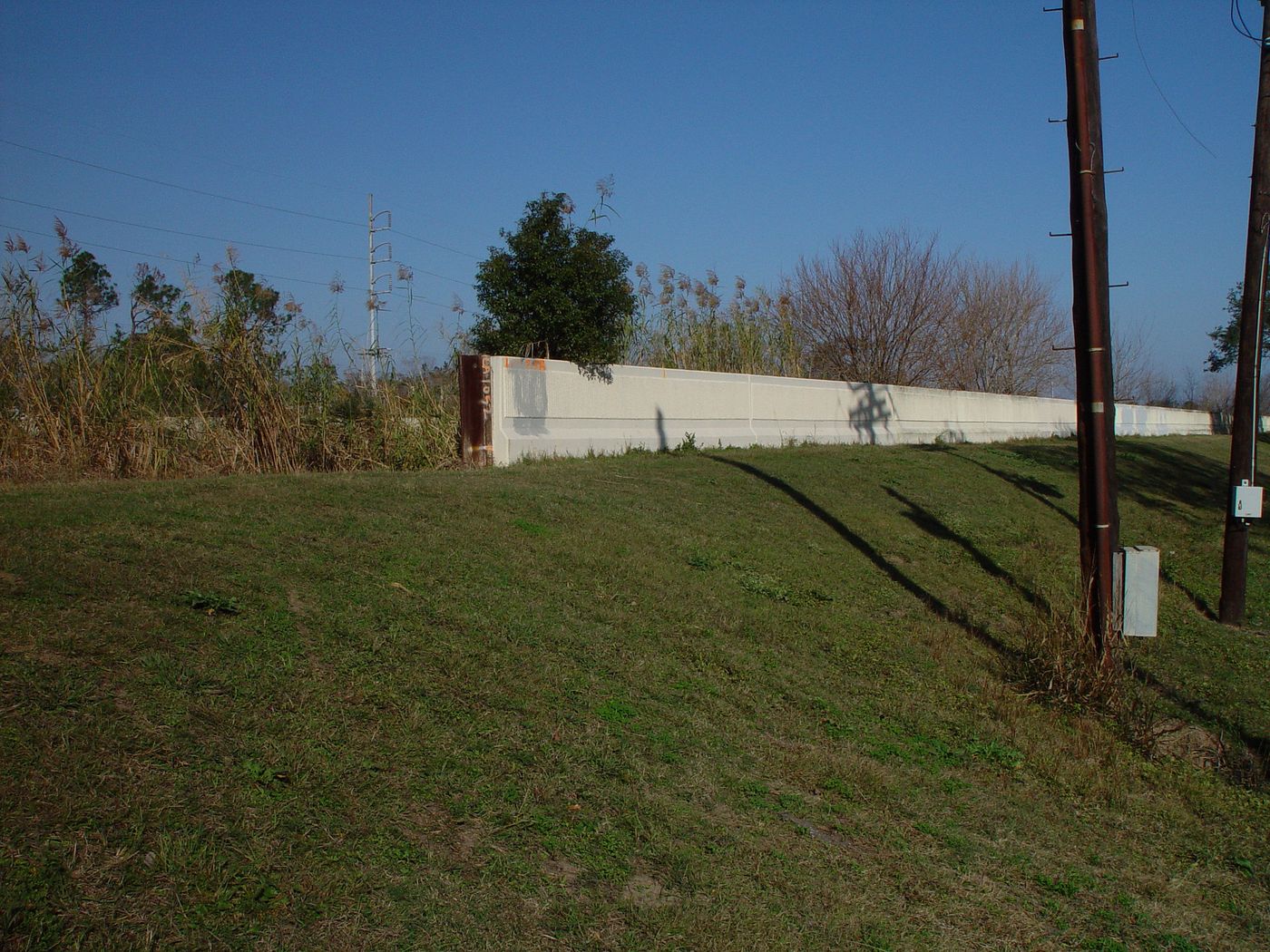
The gap was located where floodwall construction would require coordination between the Orleans Levee Board, the Sewerage and Water Board, the state Department of Transportation and Development and, possibly, the Federal Highway Administration. Since that had not been resolved when Katrina arrived, floodwaters simply poured through the open gap into City Park.
Immediately after the storm, the Orleans Levee Board took much criticism for this spillway, even though responsibility was shared by at least three organizations. Had the walls of the 17th Street and London Avenue Canals not breached, the spillway could have allowed several hours of overtopping — significant, though not catastrophic, flooding. In the end, the failures of the 17th Street and London Avenue Canals made the issue moot.
In court, and today
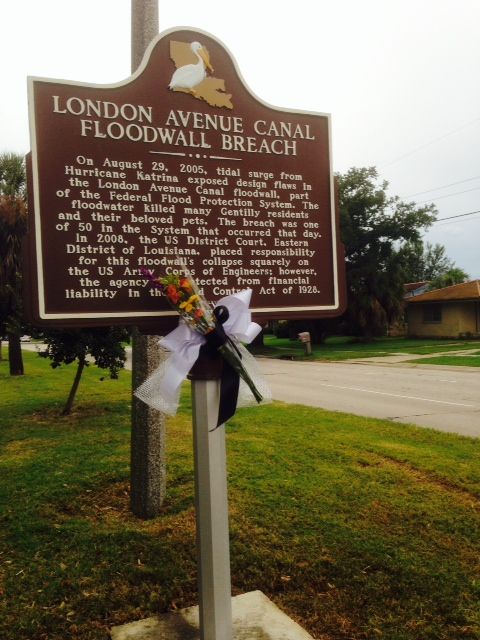
In January 2008, Judge Stanwood Duval held the U.S. Army Corps of Engineers responsible for defects in the design of the concrete floodwalls of the London Avenue Canal. Again, the agency could not be held financially liable due to the sovereign immunity provided by the Flood Control Act of 1928.
Since 2005, the Corps has strengthened the London Avenue Canal by installing gates with massive pump stations at the lake, setting a “safe water” level below the top of the wall, driving steel sheet pilings to deeper depths, and installing relief wells that act as “warning gauges.”
The drainage canals flooded the heart of the city. But the first water of the morning came from the east, through a canal that had breached in nearly the same place 40 years before.
Go deeper
Sources
- Team Louisiana, The Failure of the New Orleans Levee System during Hurricane Katrina (2007)
- Minutes of the Monthly Board Meeting, Orleans Levee District, October 17, 1990, p. 7
- In re Katrina Canal Breaches Consolidated Litigation, Judge Stanwood Duval, January 2008