
Lesson 14 of 15 Part 4: Why it matters to you
Levees everywhere
After 2005, many Americans questioned the wisdom of rebuilding a city that depends on levees. Then Levees.org asked FEMA for the data. Sixty-two percent of Americans live in counties protected by levees.
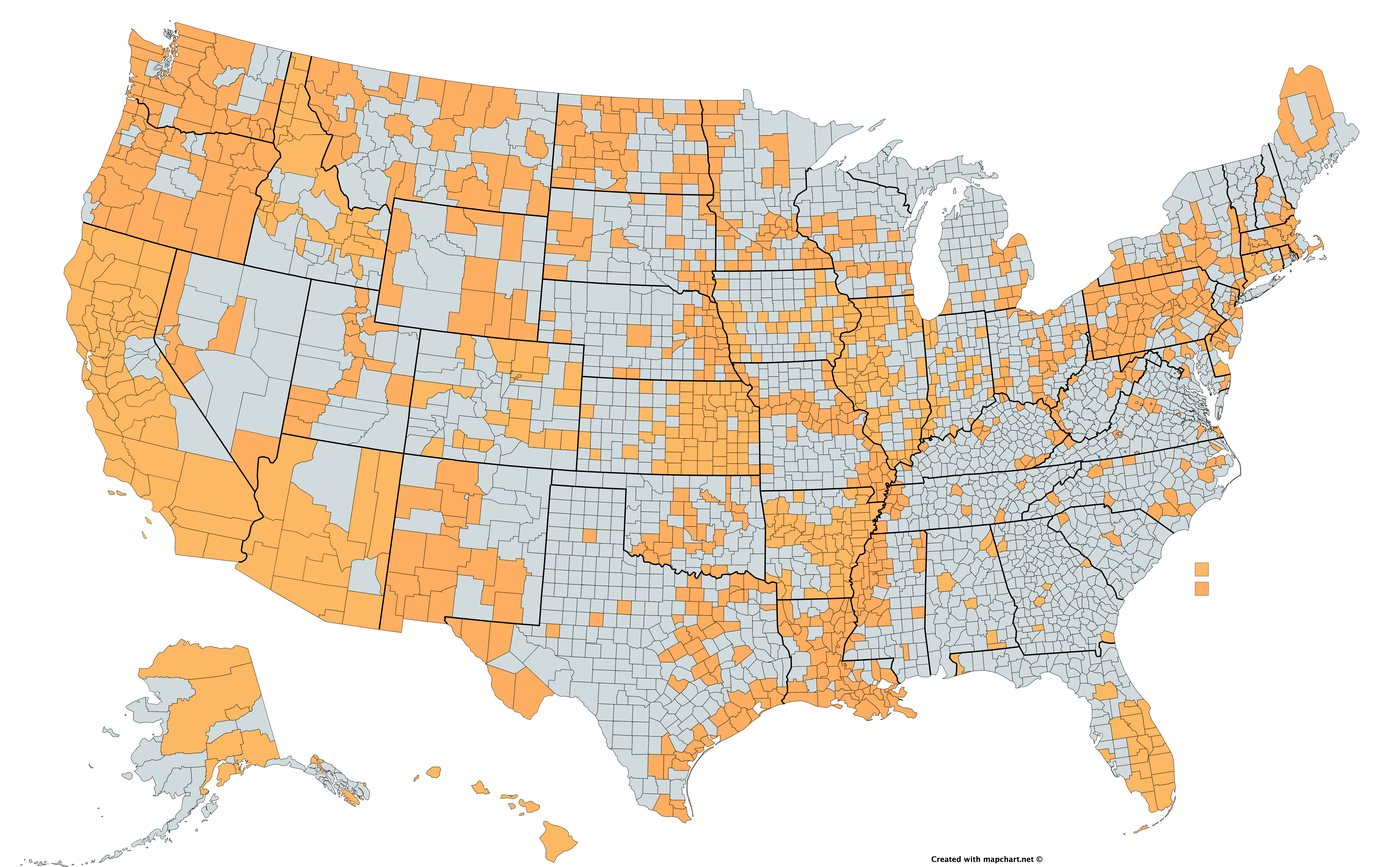
After the levees broke, the nation questioned the wisdom of further public investment in levees in New Orleans and south Louisiana. Pundits asked why anyone would rebuild a city that depends on levees to stay dry.
Levees.org asked a different question: how many other Americans depend on levees, too?
A number in a file cabinet
In 2009, Gerry Galloway told Congress that 43% of the American population lived in counties protected by levees. Levees.org wanted to know exactly where those counties were. Galloway said the data was “probably in a file cabinet somewhere at FEMA,” and suggested Levees.org ask FEMA for it.
So Levees.org filed a request under the Freedom of Information Act. Six months later, the data arrived — and the first thing Levees.org noticed was that the number wasn’t 43%. It was 55%: 156,615,630 people.
Levees.org commissioned disaster geographer Ezra Boyd to translate the mountain of data into an easy-to-read map. The result was eye-popping. Pulitzer Prize-winning reporter Mark Schleifstein put the story on the front page of the Times-Picayune on January 2, 2010. U.S. Senator Mary Landrieu used the map on Capitol Hill in her fight over flood insurance rates.
In May 2019, Levees.org filed a new request. It took more than 14 months to get an answer. The number had grown: 62% of the U.S. population — more than 201 million people — lives in counties protected by levees. According to FEMA, the increase is likely due to new and expanded levees, more people moving to places protected by levees, and better accounting of where levees are.
Not a New Orleans problem
The map shows that living in counties protected by levees is not a distinctly New Orleans phenomenon. Nor is it a coastal issue, nor a sea-level issue.
Ten states have at least two cities with populations over 300,000 in counties protected by levees. California has nine: Sacramento, Oakland, San Jose, Fresno, Los Angeles, Anaheim, Long Beach, Santa Ana and San Diego. Texas has five: Fort Worth, Dallas, Arlington, Austin and Houston. Ohio has four: Toledo, Cleveland, Columbus and Cincinnati. Arizona has three: Phoenix, Mesa and Tucson. Colorado, New Mexico, Oklahoma, Missouri, Tennessee and Florida each have two.
A major levee breach affects much more than homes. It affects businesses, government buildings, infrastructure and communication — offices, hospitals, grocery stores, schools and places of worship.
In 2008, the flooding in Cedar Rapids, Iowa, more than 700 feet above sea level, was accurately compared to the flooding in New Orleans. That same year, an embankment breached at Lake Delton, Wisconsin, 1,100 feet above sea level, and a levee broke at midnight in Fernley, Nevada, 4,200 feet above sea level.
Why people live behind levees
Thirty-nine of the nation’s 50 largest cities lie, at least in part, on a floodplain. Historically, that’s because towns and cities grew up on rivers to supply daily water needs and affordable transportation for commerce. More recently, people have moved near rivers and coasts for recreation, too. This is not madness. This is life.
Levees.org’s analysis of the FEMA data found that total productivity and personal incomes are greater, and poverty is less, in U.S. counties with levees. Levees more than pay for themselves when their cost is compared to the investment they protect.
Myth New Orleans has a peculiar geography in that it relies heavily on levees for protection.
Truth Sixty-two percent of the U.S. population lives in counties protected by levees.
Why rebuild New Orleans?
The Port of New Orleans is one of the largest and most important in the nation. The city was founded on high ground along the Mississippi River. Engineering decisions that benefited the rest of the nation — dams and flood control structures upriver, navigation canals for oil and gas — greatly increased the region’s vulnerability. But environmentalists and business interests agree that this is reversible and cost-feasible.
And if exposure to hurricanes were a reason to relocate people out of New Orleans, then we might as well relocate everyone who lives where events can be measured on a scale, be it Saffir-Simpson, Richter or Fujita. The West is spider-webbed with earthquake faults. There’s Tornado Alley. The Midwest regularly floods when rivers top their banks. California fires are an annual threat. Hurricanes threaten the entire coast from Canada to Mexico.
One of the things that gives (New Orleans) a good chance against rising sea level is the fact that this (wetlands) is a live living dynamic system. The marsh is alive. And if you give the marsh sediment from the river and fresh water, it will actually rise as sea level rises. — John Barry, author of Rising Tide, February 2010
Who builds your levee?
Responsibility for the design and construction of the levees in New Orleans — like most of the important levees in America — belongs to the U.S. Army Corps of Engineers.
This matters to all of us, because the same agency that bungled in New Orleans is responsible for most of the important water projects in this country. And that’s important because the majority of the nation’s population lives in counties protected by levees. — Sandy Rosenthal, December 2009
Until the American people see that the flooding of New Orleans was a federal responsibility, they will never see rebuilding as a federal duty — nor see that they, too, could be in danger. That is why Levees.org was founded.
If you live in one of the counties on this map, it is worth asking: Who designed my levee? Who inspects it? What grade did it get? And who would be responsible if it failed?
The final lesson is about remembering — and about making sure the next generation of engineers learns what the last one forgot.
Go deeper
- Counties with Levees
- Levees.org obtains new data showing nearly two-thirds of Americans live by levees
- The New Orleans region and its levees is not alone
- Ten states have two or more cities with populations > 300K living in counties protected by levees
- Why should you care about New Orleans' flood disaster now?
Sources
- FEMA, National Flood Insurance Program data on counties with levees, provided to Levees.org under FOIA (2009 and 2020)
- Mark Schleifstein, Times-Picayune, January 2, 2010; Mark Schleifstein and Jeff Adelson, The Advocate, August 2020