
Lesson 1 of 15 Part 1: What happened
Why the levees broke: the short answer
The flooding of New Orleans in 2005 was primarily a civil engineering disaster, not simply a weather event. Here is the whole story in five minutes.
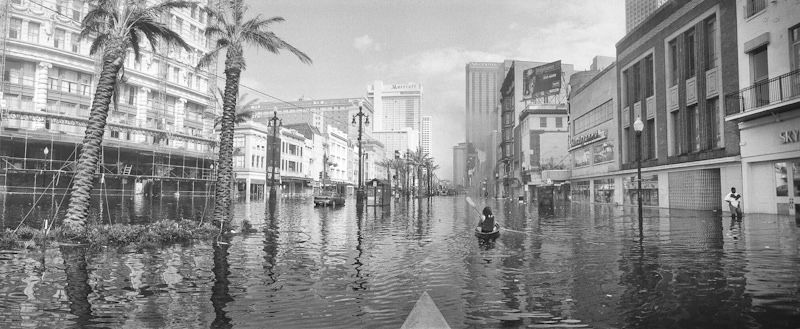
The failure of levees and floodwalls during Hurricane Katrina in 2005 has been termed “the worst civil engineering disaster in United States history.” Lt. Gen. Carl Strock, Commander of the U.S. Army Corps of Engineers — the agency responsible for the system’s performance — referred to the levee protection as a “system in name only” when he presented the Army Corps’ investigative report to Congress on June 1, 2006.
Most Americans remember something different. They remember a monster storm, a city below sea level, and people stranded on rooftops. That picture is not wrong, exactly. But it leaves out the most important fact: New Orleans flooded because the levees broke, and the levees broke because they were not properly designed and built.
This first lesson gives you the whole story in brief. The lessons that follow fill in each part.
What happened
During the morning of August 29, 2005, hurricane storm surge broke through and over protective levees and flooded 80% of New Orleans and 100% of nearby St. Bernard Parish. This system of levees and floodwalls was called the Lake Pontchartrain and Vicinity Hurricane Protection Project. It was authorized by Congress in 1965, and it was designed and built by the Army Corps.
There were about 50 breaches in the system that day. Some levees were overtopped and washed away because they had been built with sand instead of clay. But the breaches that did the most damage — on the 17th Street and London Avenue drainage canals — happened with the water well below the tops of the floodwalls. Those walls simply fell over.
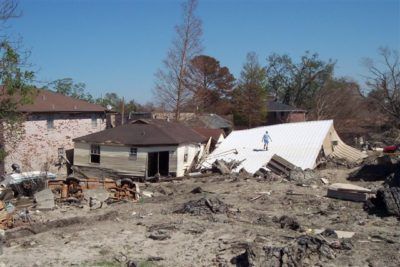
On January 4, 2023, the National Hurricane Center updated the fatality data for Hurricane Katrina to 1,392 deaths. The analysis behind the update observed that the 2005 storm “stands apart not just for the enormity of the losses, but for the ways in which most of the deaths occurred.” A study of the dead published in 2009 showed that most of the victims were elderly or lived near breach sites.
Why the walls fell
After Hurricane Betsy flooded parts of the city in 1965, Congress put the Army Corps in charge of designing and building hurricane protection for metro New Orleans. In the 1980s, the Corps raised the walls along the city’s major drainage canals by driving steel sheet piling into the levees and capping it with concrete. These are called I-walls.
To limit costs, the Corps ran a large-scale sheet pile load test near Morgan City, Louisiana. The Corps misinterpreted the results and wrongly concluded it could drive the steel sheet pilings to depths of not more than 17 feet instead of between 31 and 46. The switch saved about $100 million. According to the federal government’s own Decision-Making Chronology, those savings “came at the expense of engineering reliability.”
On August 29, 2005, the short sheet piles let water seep under the walls and the soft soils beneath them gave way. The walls slid sideways and collapsed.
Metro New Orleans was not wiped out by a hurricane. Metro New Orleans was wiped out by a federal project done wrong.— Sandy Rosenthal, Levees.org kickoff rally, January 21, 2006
Who was responsible
Every major investigation found engineering failures. In January 2008, federal Judge Stanwood Duval held the Army Corps responsible for the floodwall failures on the 17th Street and London Avenue Canals. But the agency could not be held financially liable, because the Flood Control Act of 1928 gives it immunity.
For years, the Corps also told the press that local officials, environmentalists, and New Orleanians themselves shared the blame. In 2015, the authors of the very first levee investigation retracted their conclusion that the Orleans Levee Board contributed to the canal wall failures. They laid the blame where it belonged: on a mistake the Army Corps made in the 1980s when interpreting its own load test.
Why it matters to you
Sixty-two percent of the American population — more than 201 million people — lives in counties protected by levees. The most important of those levees are built by the same federal agency.
After 2005, Congress passed the first nationwide levee safety legislation, and the Army Corps changed the way it designs I-walls and inspects levees everywhere. The levee breach event was not a shining moment for American engineering, but it was a pivotal moment in American history. It made the majority of the American people safer from flooding — but only if we remember what actually happened.
No one blames the iceberg In 1889, a badly maintained dam broke in Johnstown, Pennsylvania, and killed 2,209 people. No one blames the rain. In 1912, the Titanic ignored ice warnings and carried too few lifeboats. No one blames the iceberg. Levees.org will say “mission accomplished” when, with regard to the catastrophic flooding during Hurricane Katrina, no one blames the hurricane.
In the next lesson, we go back to the weekend before the storm and follow what happened, hour by hour.
Go deeper
- Levee Exhibit with PhotosThe full, expert-reviewed text of Levees.org's Levee Exhibit Hall.
- Sandy Rosenthal's kickoff rally statement (January 21, 2006)
- When No One Blames the Hurricane
Sources
- Interagency Performance Evaluation Task Force (IPET), U.S. Army Corps of Engineers, 2006–2009
- Rogers, Kemp, Bosworth & Seed, “Interaction between the US Army Corps of Engineers and the Orleans Levee Board preceding the drainage canal wall failures,” Water Policy 17(4), 2015
- Woolley & Shabman, Decision-Making Chronology for the Lake Pontchartrain & Vicinity Hurricane Protection Project, 2008